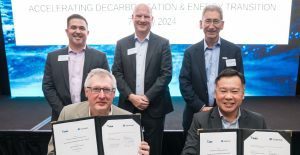
The Massachusetts Institute of Technology (MIT) has launched the MIT Maritime Consortium, a new international collaboration aimed at developing nuclear propulsion technologies, alternative fuels, and data-driven operational strategies for shipping.
The consortium brings together industry and academic partners to support maritime decarbonisation efforts in line with International Maritime Organisation (IMO) targets.
“This is a timely collaboration with key stakeholders from the maritime industry with a very bold and interdisciplinary research agenda that will establish new technologies and evidence-based standards,” said Themis Sapsis, the William Koch Professor of Marine Technology at MIT and the director of MIT’s Center for Ocean Engineering.
“It aims to bring the best from MIT in key areas for commercial shipping, such as nuclear technology for commercial settings, autonomous operation and AI methods, improved hydrodynamics and ship design, cybersecurity, and manufacturing.”
The consortium is co-led by Themis Sapsis and Fotini Christia, director of MIT’s Institute for Data, Systems, and Society. It includes MIT research groups from multiple departments, along with founding members American Bureau of Shipping (ABS), Capital Clean Energy Carriers, and HD Korea Shipbuilding and Offshore Engineering. Innovation members include Foresight-Group, Navios Maritime Partners, Singapore Maritime Institute, and Dorian LPG.
Research will focus on nuclear propulsion system designs suited for commercial shipping, economic and environmental feasibility of alternative fuels, AI-driven decision-making tools, cyber-physical security, and onboard 3D printing technologies. The consortium will also support the development of evidence-based standards aligned with MIT’s priorities in climate, sustainability, and AI.