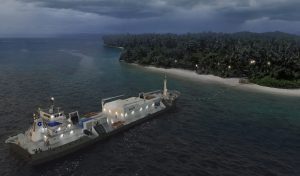
A new study from Lloyd’s Register and LucidCatalyst for Seaspan Corporation says that nuclear propulsion could remove bunker costs, cut greenhouse gas emissions and deliver higher cargo capacity on future containerships. The research examines the potential for integrating small modular reactors into fleet operations and assesses requirements to support commercial deployment.
The analysis finds that operators could eliminate up to $50 million in annual bunker fuel costs and around $18 million in carbon penalties per vessel. A 15,000 TEU ship running at 25 knots could complete 6.3 round voyages per year, compared with five using conventional propulsion, and gain 5% additional cargo capacity through the removal of fuel tanks and associated systems.
The report notes that a requirements-led procurement approach, delivered through a cross-industry consortium, would be central to building a competitive supply chain. If the market commits to purchasing more than 1,000 units over 10–15 years, the study estimates that reactors could be produced for US$750–1,000 per kilowatt, maintained during standard drydock cycles and refuelled on five-year intervals.
The study proposes that an intensive development programme could bring nuclear propulsion units to commercial readiness within four years, with system costs below $4,000/kW and fuel costs under $50/MWh. Market modelling projects uptake of 40–90 GW by 2050, subject to regulatory progress.
The work forms the first phase of a three-part programme, with upcoming stages focused on concept design, regulatory readiness and deployment planning.
“As part of our ongoing efforts to find safe and commercially viable energy transition pathways, we have partnered with LR and Lucid Catalyst to explore nuclear propulsion for containerships,” said Peter Jackson, Chief Technology Officer at Seaspan Corporation.
“Small Modular Reactors (SMR’s) is a very exciting technology offering several desirable benefits for shipowners and operators, as outlined in this report. Naturally there are challenges to overcome, but I am confident that ongoing work in this area and studies like this will soon allow nuclear powered containerships to be operating safely, economically, and emission free.”