

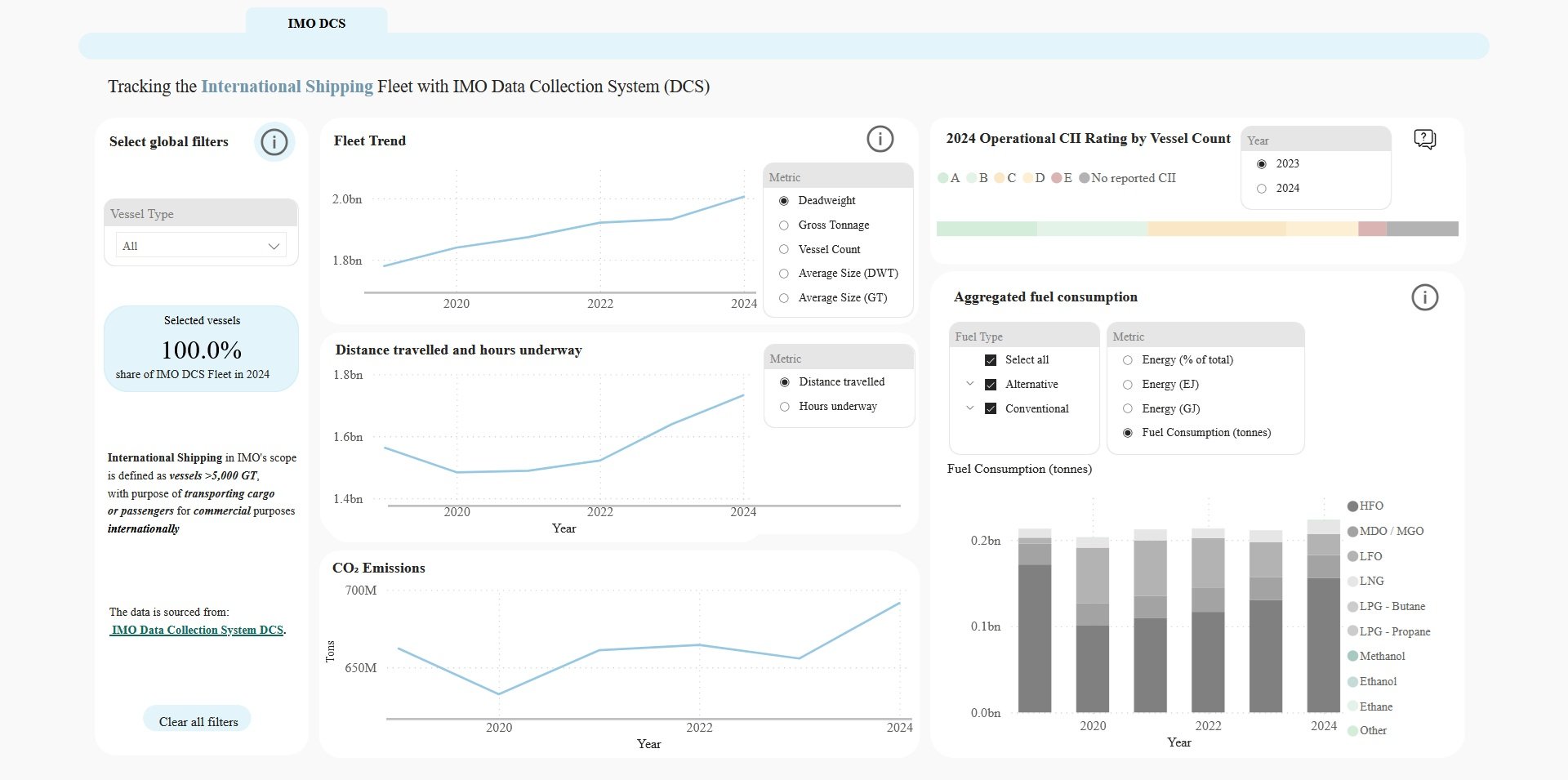
The Maersk Mc-Kinney Møller Center for Zero Carbon Shipping has released a new interactive dashboard based on International Maritime Organization Data Collection System (IMO DCS) data.
The tool tracks six years of reporting to provide a view of how the international fleet is evolving in terms of growth, fuel consumption, emissions, and operational efficiency.
The Center says that data from the platform indicates the fleet has expanded continuously since 2019, with more vessels and larger overall capacity. Growth has been notably strong in the container segment, which recorded approximately 8% more vessels in 2024 than in 2023, with an average capacity increase of 4%.
This fleet expansion and an increase in distance travelled have pushed reported carbon dioxide (CO2) emissions to roughly 4% above 2019 levels. This brings total CO2 emissions close to the 2008 baseline used for international reduction targets.
While absolute emissions have risen, the Center noted that this trend does not fully mirror seaborne growth due to significant improvements in vessel efficiency.
Non-conventional fuel consumption remains marginal, accounting for approximately 0.5% of total fuel use in 2024. Growth in this category is being driven by the uptake of methanol and biofuels. The container segment showed the highest adoption rate, with non-conventional fuels representing around 1% of its total consumption.
Despite the rise in total emissions, operational efficiency has improved. In 2024, approximately 70% of the fleet achieved A, B, or C Carbon Intensity Indicator (CII) ratings, an increase of 3 percentage points compared to the previous year.
The dashboard can be accessed here.


